
Why Your Solar Panel’s Tilt Angle Matters More Than You Think
Most people assume solar panels simply need “sunlight” to work — point them roughly upward, and the job is done. In reality, the angle at which your panel meets the sun’s rays determines how much of that free energy actually gets converted into usable electricity. Get the tilt right, and you maximise every unit of generation your TANGEDCO net-metering connection can bank. Get it wrong, and you’re leaving real money on your roof — all while shrinking the subsidy value you’d otherwise recover through PM Surya Ghar.
Here’s the physics, step by step.
Understanding irradiance and the sun’s path isn’t just an academic exercise — it’s the foundation every correctly engineered solar installation is built on. Before a single panel goes on your roof, this is the science our team runs through for every site in Tamil Nadu.
1. The Macro View:
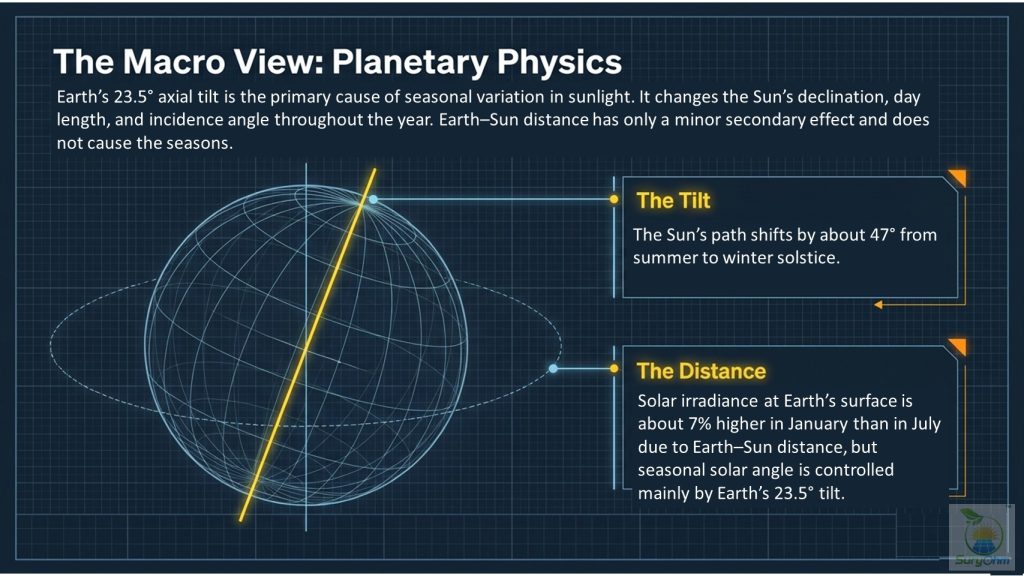

Earth’s 23.5° axial tilt — not its distance from the sun — is what drives the huge seasonal swing in sunlight, shifting the sun’s path across the sky by roughly 47° between the summer and winter solstice. This matters practically because a panel installed flat or at the wrong angle will be well-aligned with the sun for only part of the year, losing output during the rest.
2. The Sky View: Mapping the Sun’s Actual Path

While the sun always rises in the east and sets in the west, its height in the sky changes dramatically — tracing a low arc in winter and a much higher one in summer. Since a fixed panel can’t physically move to chase these two very different trajectories, its tilt has to be chosen as the best possible compromise across the whole year, not just for a single “perfect” day.
3. The Physics of Light: Not All Sunlight Arrives the Same Way
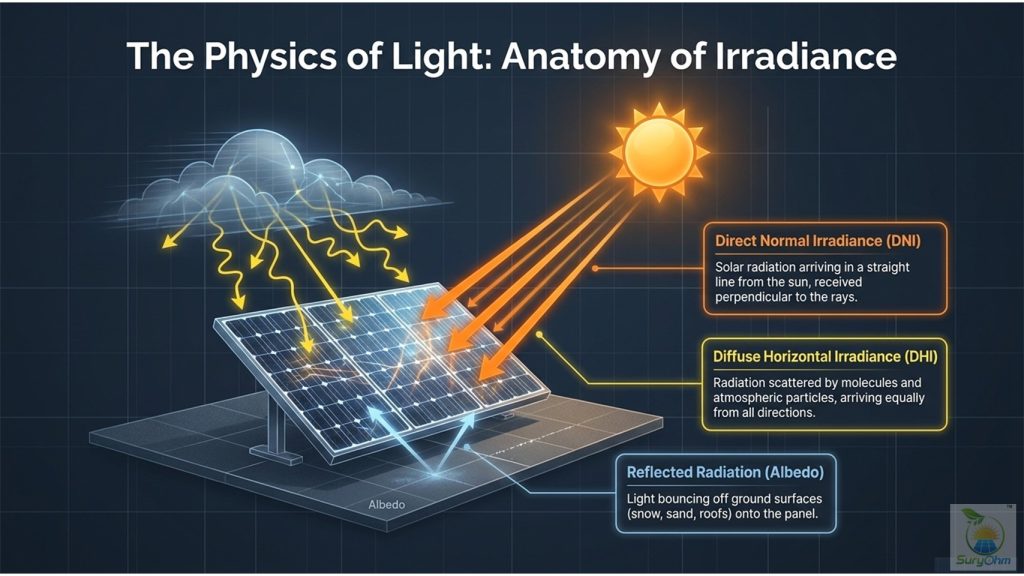
Sunlight reaching your panel isn’t a single beam — it’s a mix of Direct Normal Irradiance (DNI) striking straight from the sun, Diffuse Horizontal Irradiance (DHI) scattered by clouds and atmosphere, and reflected “albedo” light bouncing off the ground and nearby surfaces. A well-tilted panel is angled to capture the maximum combination of all three, not just the strongest direct beam.
4. Synthesizing the Light:
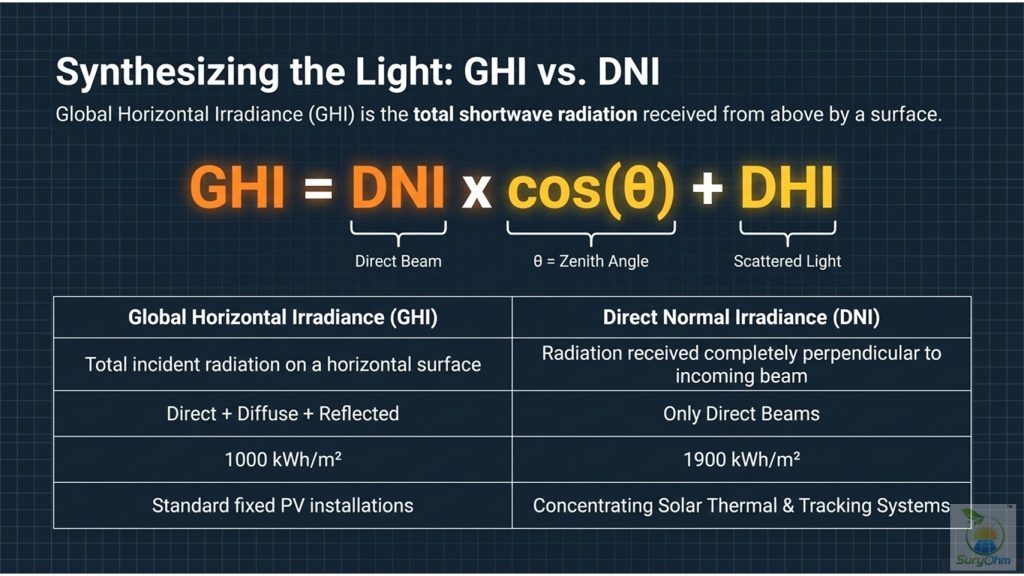
The formula GHI = DNI × cos(θ) + DHI explains exactly why tilt angle is a mathematical lever on output: as the zenith angle θ moves closer to zero (sunlight hitting the panel more directly), the cosine term climbs toward its maximum, directly boosting the total Global Horizontal Irradiance the panel absorbs. This is the single equation that separates a mediocre installation from a high-yield one — it’s why standard fixed PV systems are designed around GHI, while only specialised tracking systems can chase DNI directly.
5. The Actionable Engineering Rule
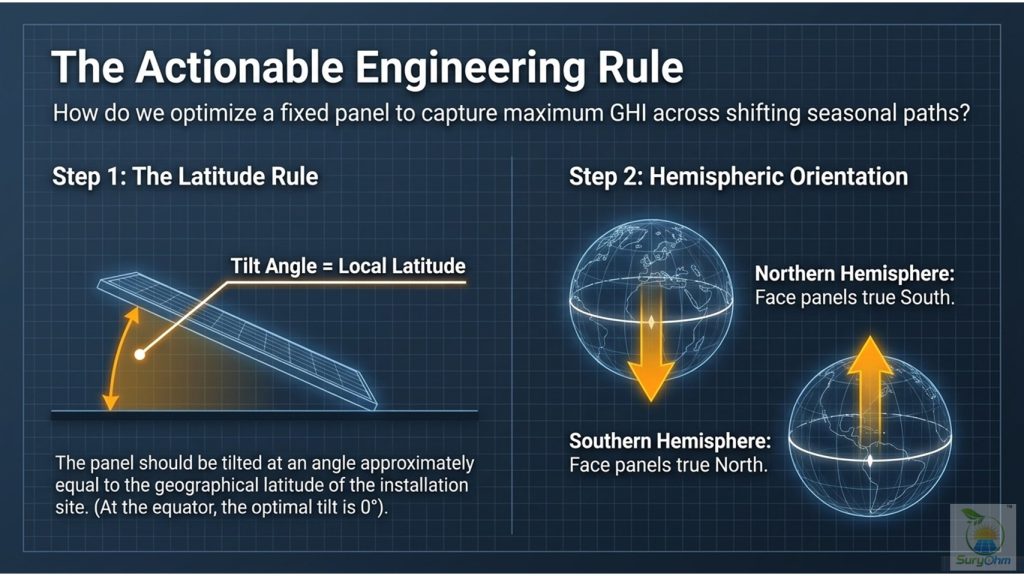
The practical takeaway is simple: tilt angle should approximately match the site’s local latitude, with panels facing true south in the Northern Hemisphere (true north below the equator) to capture the best average across all shifting seasonal sun paths. For Tamil Nadu specifically, this rule translates to a shallow 10°–15° tilt — noticeably flatter than the 28°–30° used further north — with Coimbatore and Trichy at roughly 10° and Chennai closer to 13°
The Bottom Line
A correctly tilted panel isn’t a minor engineering detail — it’s the difference between an installation that merely works and one that performs at its true potential across every season of the year. At Thannirai Tech Systems, every rooftop we design in Coimbatore, Trichy, and Karur starts with this same latitude-based tilt calculation, ensuring you get maximum lifetime generation, faster payback, and the full benefit of your PM Surya Ghar subsidy and TANGEDCO net-metering credits.