What is DCR
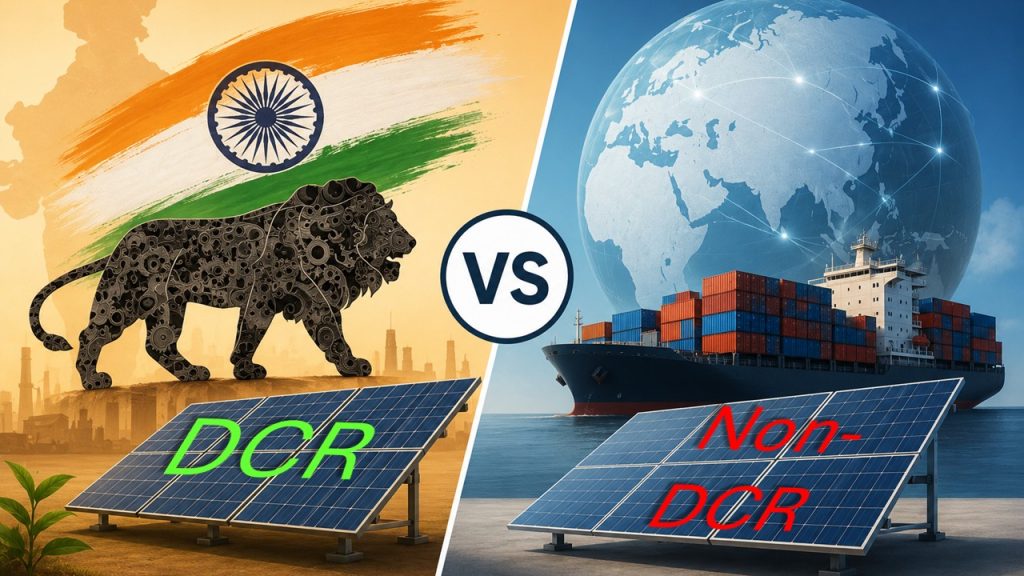
DCR stands for Domestic Content Requirement. A module qualifies as DCR-compliant only when both the solar cells and the module assembly are manufactured within India, using domestically produced silicon wafers through to the finished cell. A DCR-compliant solar module must satisfy that its solar cells are manufactured in India using undiffused silicon wafers, with all manufacturing processes from wafer to finished cell carried out within India.
This is operationalised in practice through ALMM (Approved List of Models and Manufacturers), maintained by MNRE, which now has two tiers:
- List-I — approved module manufacturers/models (in force since April 2022)
- List-II — approved cell manufacturers, mandatory from 1 June 2026
List-I functions as the panel-level stamp of approval, while List-II is the stamp of approval for what’s inside the panel — the cells themselves. Non-DCR panels simply don’t meet this domestic-manufacturing bar — they use imported components, cells or modules, typically sourced from countries like China or Vietnam.
Why does it exist?
The Approved List of Models and Manufacturers was implemented from 1 April 2022, mandating the type and source of solar modules used for projects under central and state government contracts — notably, ALMM covers only domestic solar modules, excluding Chinese modules, which accounted for roughly 70-80% of all solar installations in India up to that point.
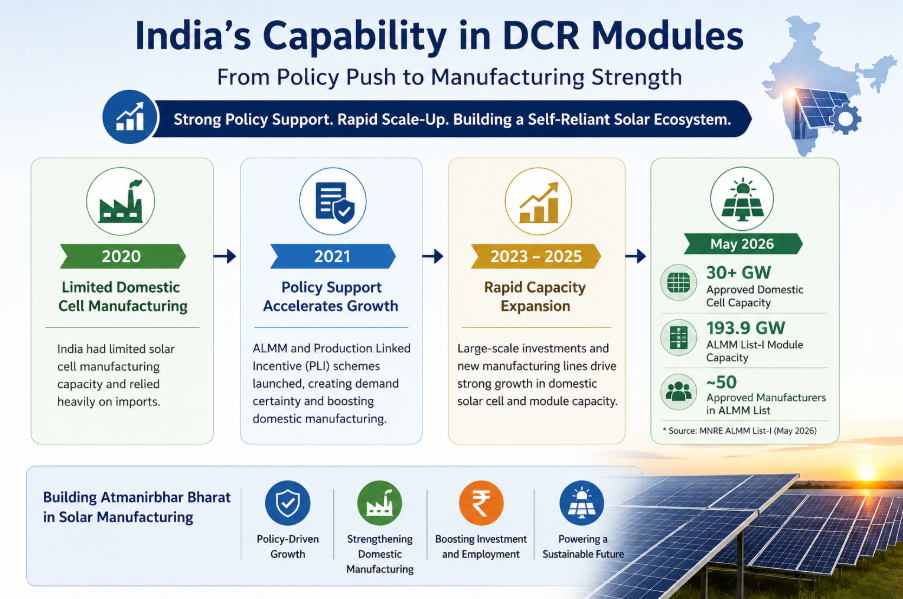
The policy exists to build a domestic solar manufacturing base that otherwise couldn’t compete on price against established overseas supply chains. DCR creates predictable, guaranteed demand that justifies the capital investment required for gigawatt-scale solar cell manufacturing — without it, Indian cell manufacturers would struggle to compete with Chinese imports at global spot prices. The results are measurable: the combination of limited DCR, basic customs duty on imported modules, and the PLI (Production Linked Incentive) scheme has driven Indian solar manufacturing capacity from under 3 GW in 2020 to over 60 GW in 2026.
Worth knowing: this wasn’t India’s first attempt. A broader DCR mandate was rolled back after WTO challenges in 2016, and current provisions are narrower, targeting specific government procurement categories where WTO rules permit domestic preference.
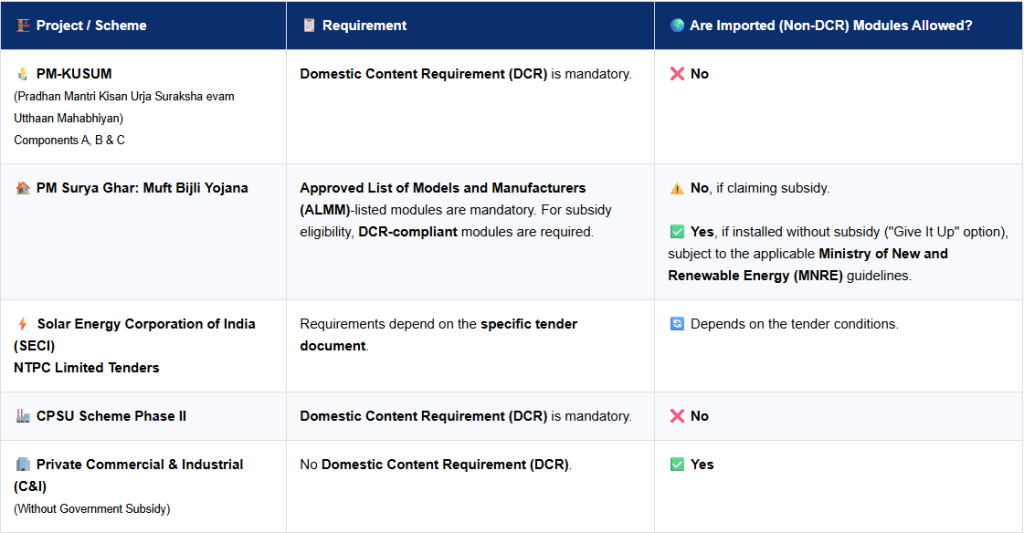
What projects can use DCR and non-DCR?
What is the financial impact?
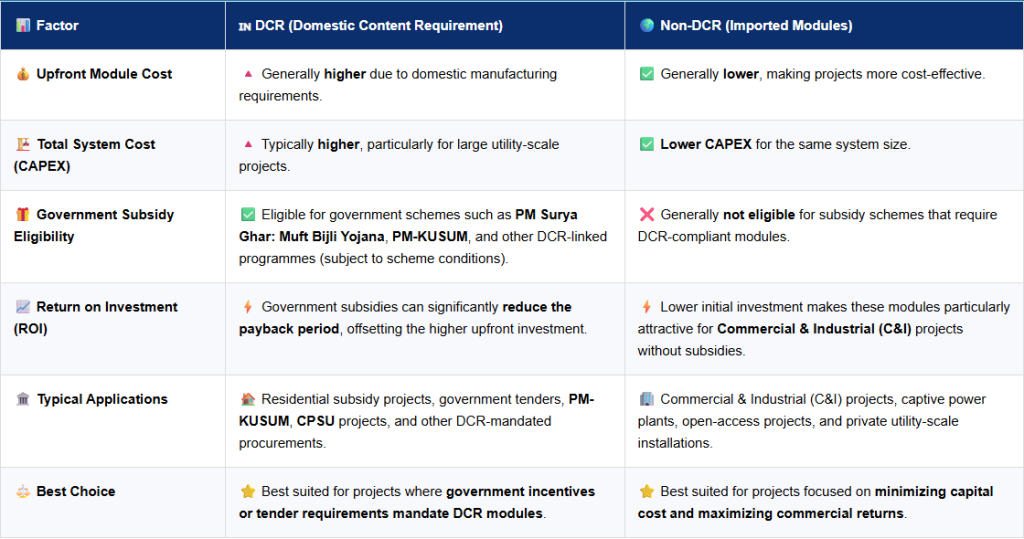
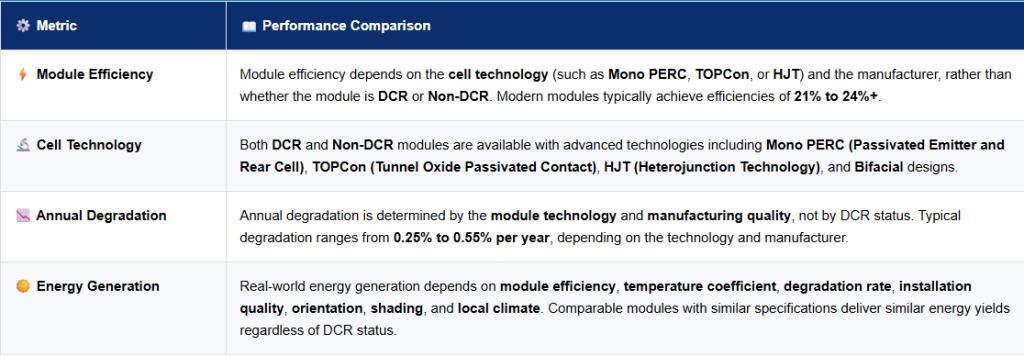
Efficiency and performance: DCR vs non-DCR
India’s capability in DCR modules
The scale-up has been substantial: Indian cell manufacturing capacity has grown from effectively zero in 2020 to over 30 GW of ALMM-listed capacity in 2026, driven largely by the demand certainty DCR policy created. As of May 2026, ALMM List-I module capacity has surpassed 193 GW across approximately 50 manufacturers, including established players like Waaree, Adani Solar, Tata Power Solar, Vikram Solar, and Premier Energies.